-
ALTERNATIVE PRACTICES AND
UNBOUND FORMS:
AFRICAN ARTISTS ACROSS RECENT BIENNALES
JOËL ANDRIANOMEARISOA, HAKO HANKSON, ABDOULAYE KONATÉ, TEGENE KUNBI, ESTHER MAHLANGU, TROY MAKAZA, SAMUEL NNOROM, MOFFAT TAKADIWA
09.04.2026 | 30.06.2026
PRIMO MARELLA GALLERY MILANO
Via Valtellina 31, 20159 Milano, Italy
-
-
Primo Marella Gallery Milano is pleased to announce its new group exhibition, Alternative Practices and Unbound Forms: African Artists Across Recent Biennales, on display in our Milan venue.Alternative Practices and Unbound Forms: African Artists Across Recent Biennales takes shape as a critical and sensitive mapping of artistic practices developed within the African context and emerging through recent international biennales. The exhibition foregrounds the moment in which material ceases to function as mere support and assumes the role of language and structural foundation of the work.Within these practices, the use of non-conventional materials –heterogeneous, residual, organic, or industrial – is not driven by decorative intent, but rather inscribes itself within an epistemological redefinition of art: a construction that originates from the material itself, allowing its processes of accumulation, stratification, and tension to generate form and meaning.Far from being reducible to ethnic categories or narrowly identity-based readings, the artists brought together here develop autonomous and recognizable visual vocabularies, capable of resisting any exoticizing taxonomy. Their works reveal the use of material as an operative field: surfaces built through addition, compression, or stitching; modular elements that expand into space; and structures that grow into immersive environments.Material is never neutral: it incorporates use, provenance, memory, and gesture, becoming an active principle of composition.What a decade ago was perceived as radical experimentation has now established itself as one of the most incisive trajectories in contemporary practice, where knotting, sewing, weaving, assembling, and painting become repeated and transformative gestures, capable of rendering surfaces, bodies, and installations both traversable and inhabitable.
-
From the early editions of the Venice Biennale between the 1930s and 1970s, it is evident that African and Afro-descendant artists were long marginalized within a Eurocentric exhibition system. In more recent editions, however, a radical reversal of this paradigm has taken place: these practices now occupy a central position, contributing significantly to the shaping of contemporary curatorial discourse.This current visibility is therefore not the result of a gradual opening, but the outcome of a profound transformation in the criteria through which contemporary art is interpreted and legitimized. Within this context, all the artists presented here have participated in the Venice Biennale in recent years or will be included in its 2026 edition – In Minor Keys, curated by Koyo Kuoh.Each recent biennale confirms not only an established presence, but above all the tangible impact of these practices on the redefinition of the contemporary.As Simon Njami observes, this is not merely the inclusion of an emerging phenomenon, but the recognition of an already active presence, capable of profoundly reshaping a global art system long perceived as monolithic.
-
-
The curatorial framework articulated by the title Alternative Practices and Unbound Forms allows these practices to be understood along two complementary trajectories.Alternative Practices brings together artists who make material the structural principle of the work. Moffat Takadiwa transforms plastic, cables, and industrial residues into stratified surfaces, rendering visible global dynamics of consumption and circulation, while Troy Makaza develops an original material language in which paint-infused silicone becomes the constitutive principle of the work, generating density and vibration through processing rather than accumulation. Abdoulaye Konaté produces monumental textiles composed of repeated modules and expansive fields of color, imposing an all-encompassing spatial vision, while Samuel Nnorom constructs three-dimensional volumes through knotting, padding, and stitching, in dialogue with Konaté’s monumentalism. The use of color and embroidery is not ornamental but structural: it builds rhythm, density, and physical presence. Joël Andrianomearisoa creates linguistic environments through textiles and lightweight materials, transforming spatiality into an emotional experience.Unbound Forms shifts the focus from material to the construction of form, privileging structural non-conventionality and compositional freedom. Esther Mahlangu develops an abstract geometric language that, through sculptural and beaded objects rooted in South African craft traditions, evokes tridimensionality and recalls motifs of African geometric systems; Hako Hankson, within the pictorial realm, elaborates fragmented forms and ethnic references as a complementary pole within the same spectrum. Their joint participation in the 2024 Venice Biennale – Stranieri Ovunque – highlights the possibility of articulating divergent outcomes within a shared conceptual horizon. Tegene Kunbi integrates textiles – at times precious, at times ordinary – into painting through schemes based on bisectors or apparent symmetries, creating a synthesis of oil and fabric in which each element assumes structural value, determining rhythm, density, and depth.Within this trajectory, experimentation focuses on the configuration of the work and its internal articulation, rather than on the nature of the materials employed.
-
The works gathered in Alternative Practices and Unbound Forms: African Artists Across Recent Biennales oscillate between intimate scale and monumental dimension, between memory and anticipation. In all of them, material acts as a threshold: something to be traversed both visually and physically, where past, present, and possible futures intertwine, rendering visible what, to quote James Baldwin, is “the evidence of things not seen.”From this convergence emerges the unequivocal assertion of a New African Art: not a label, but a constellation of practices that concretely and tangibly redefine the construction of form, space, and meaning in contemporary art.
-
ALTERNATIVE PRACTICES and UNBOUND FORMS:
AFRICAN ARTISTS ACROSS RECENT BIENNALES
PART II
a NEW INSTALLATION
featuring MONUMENTAL NEW WORK
by ABDOULAYE KONATÉ
PRIMO MARELLA GALLERY MILANO
Via Valtellina 31, 20159 Milano, Italy
-
Primo Marella Gallery Milano is pleased to announce the unveiling of Alternative Practices and Unbound Forms: African Artists Across Recent Biennales – Part II.Open to the public from today, this renewed chapter of the exhibition unfolds through a reconfigured display centred around the presentation of a major new work by Malian artist Abdoulaye Konaté: Hommage aux chasseurs et musiciens du Mandé (2026).Conceived as a new chapter within the exhibition, the reinstallation creates fresh dialogues between the artists on view while offering visitors a renewed perspective on the richness, complexity and diversity of contemporary African artistic practices.At the heart of the new display stands Konaté’s monumental textile composition, measuring 705 × 220 cm, the largest work ever produced within this celebrated cycle and the most ambitious iteration of a subject that has remained central to the artist’s practice for more than three decades.This new work represents a monumental reimagining of one of Konaté’s most iconic and enduring themes. For over three decades, Konaté has explored the symbolic legacy of the chasseurs du Mandé – legendary hunters and spiritual guardians of the medieval Mandé Empire – whose history continues to resonate as a powerful metaphor for cultural identity, collective memory and resilience.Through his distinctive use of textile, colour and symbolic form, Konaté translates historical narratives into contemporary visual language. In Hommage aux chasseurs et musiciens du Mandé, the artist extends this reflection by paying tribute not only to the hunters but also to the musicians and custodians of oral tradition who have preserved and transmitted the cultural heritage of the Mandé world across generations. The work becomes a meditation on memory, continuity and the enduring relevance of ancestral knowledge in the present. Particularly significant is the presence of authentic materials sourced directly from Mandé hunting communities. Among the numerous objects incorporated into the composition are genuine ritual amulets, hunting horns and animal hair originating from animals hunted by the community itself.These elements, traditionally used by the hunters in their spiritual and everyday practices, introduce an exceptional degree of figuration and material specificity within Konaté’s oeuvre, reinforcing the work’s connection to lived cultural traditions while blurring the boundaries between artwork, historical testimony and collective memory.The Mandé Hunters cycle occupies a pivotal place in Konaté’s career and in the broader history of contemporary African art.An early work from the series, L’Hommage aux chasseurs du Mandé (1994–96), received the prestigious Grand Prix Léopold Sédar Senghor at the Dakar Biennale in 1996. A monumental version of the work was presented at Documenta 15 in Kassel in 2022, while another entered the collection of the Museum of Modern Art (MoMA), New York, in 2023.These milestones underscore the international significance of a body of work that continues to shape critical conversations around contemporary art, history and cultural heritage.Through a carefully reconsidered spatial framework, Alternative Practices and Unbound Forms: African Artists Across Recent Biennales – Part II encourages new connections between artists, generations and geographies, highlighting the plurality of perspectives, materials and methodologies that define contemporary African practices today.
-
-
ALTERNATIVE Practices AND UNBOUND FORMS:
AFRICAN ARTISTS ACROSS RECENT BIENNALES
JOËL ANDRIANOMEARISOA, HAKO HANKSON, ABDOULAYE KONATÉ, TEGENE KUNBI,
ESTHER MAHLANGU, TROY MAKAZA, SAMUEL NNOROM, MOFFAT TAKADIWA
09.04.2026 | 30.06.2026
PRIMO MARELLA GALLERY MILANO
Via Valtellina 31, 20159 Milano, Italy -
PREVIEW
Please click the link below to view the artworks. -
Works
-
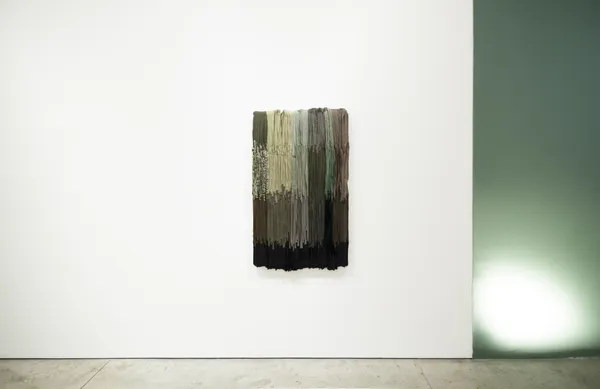
 Joël Andrianomearisoa, PROMENADE (Labyrinth of passion green process), 2026, Textile, 120 × 70 cm
 -
Hako Hankson, Converts to Christianity, 2024, Acrylic and Indian Ink on canvas, 200 × 200 cm
-
Tegene Kunbi, Look and Laugh, 2022, Oil and textile on canvas, 221 × 201 × 5 cm
-
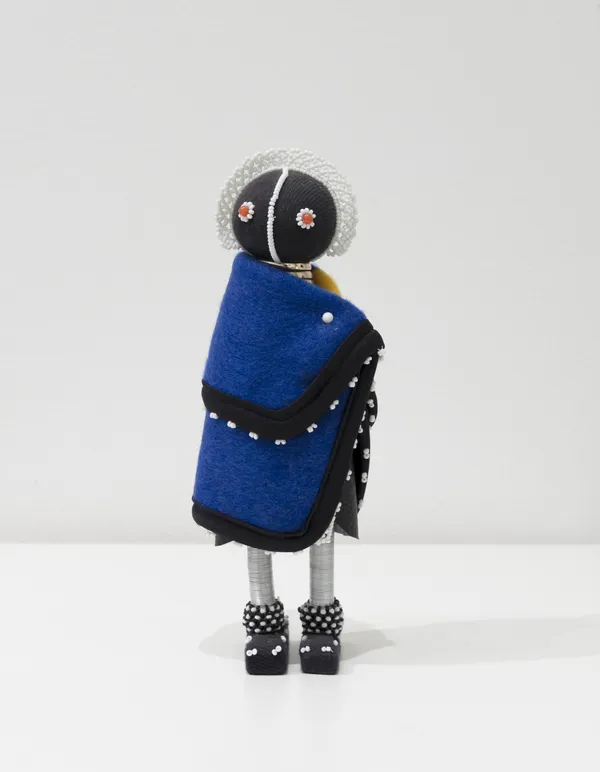
Esther Mahlangu, Untitled, 2009, Mixed media and beads, 48 × 9 cm
-
Esther Mahlangu, Untitled, 2009, Sculpture in fabric, beads and assemblage of various materials, 28 × 12 × 8 cm
-
Troy Makaza, The invisible threshold 2, 2026, Silicone infused with pigment, 193,5 × 95 cm
-
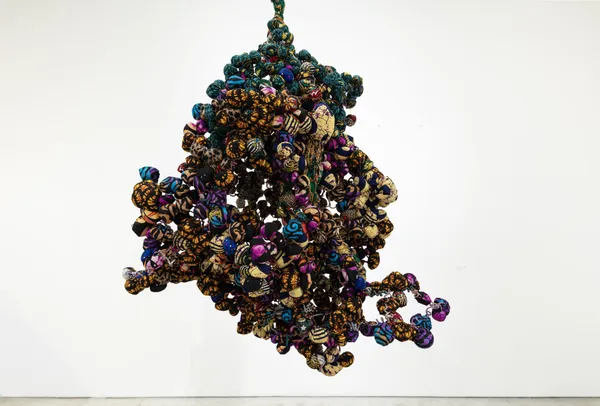
Samuel Nnorom, Attachment, 2024, African print fabric, 120 × 180 × 70 cm
-
Moffat Takadiwa, KoreKore hand writing VII, 2023, Keyboard keys and plastic toothbrush head, 266 × 178 × 15 cm
-
-
Installation Shots